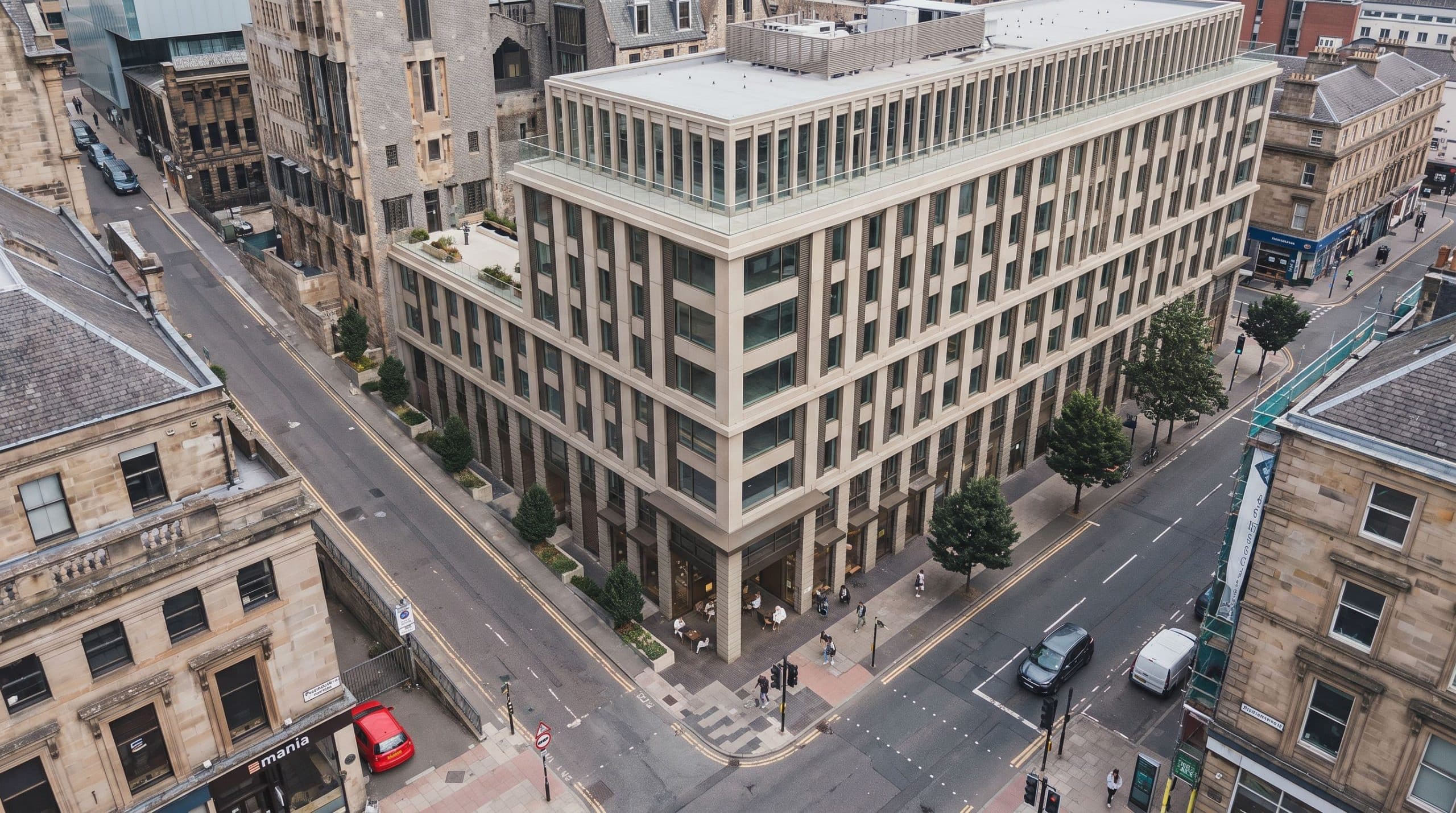

An artist’s impression of the proposed development neighbouring Glasgow School of Art. The ongoing planning dispute in Glasgow has become a focal point in the discussion surrounding purpose-built student accommodation (PBSA). Almost a decade has passed since the iconic ABC venue, previously a vibrant concert space and nightclub, last echoed with music. Following its severe damage during the second fire at the Glasgow School of Art (GSA), the structure was partially demolished after being deemed unsafe by local authorities. Now, it is surrounded by graffiti-covered boards and stands as the centre of a contentious planning application.
Last summer, the local planning committee approved an ambitious proposal to transform the site into a 365-bed student housing development, which would also feature a food hall and events space. However, this decision triggered a wave of objections, with a staggering 130 formal complaints lodged against the project. Opponents argue that the proposed nine-storey construction will obstruct views of the renowned Charles Rennie Mackintosh building, which is part of the art school’s heritage and is awaiting restoration. Conversely, supporters claim that the development will breathe new life into the area.
Delays have plagued the process, with a report to the Scottish Government, initially due in late May or early June, still outstanding. The Planning and Environmental Appeals Division (DPEA) has confirmed that they have not received the report, leaving many in the community in limbo. A spokesperson mentioned that the DPEA is currently managing a high volume of casework and will publish updates as they become available.
The Broader Context of Student Accommodation
The ongoing saga unfolds against a backdrop of increasingly politicised discussions surrounding housing in Glasgow and beyond. The dialogue isn’t solely focused on the basic supply of housing; it intertwines with deeper issues of identity, wealth distribution, and social tensions. Amidst the more vocal debates regarding social housing access, purpose-built student accommodation has also sparked significant discussion.
Much of the current PBSA supply is not only driven by universities but also by private developers. Although these facilities often provide appealing communal amenities like gyms and social spaces, the reality for some students is that these private accommodations can be cramped. In fact, some have likened them to Scandinavian jails, which, ironically, offer more comfort than certain PBSA units. Professor Ken Gibb, director of the UK Collaborative Centre on Housing Excellence (Cache) at the University of Glasgow, commented, “The original argument in favour of PBSA was to try and depoliticise the studentification of tenemented neighbourhoods. What it’s done is create a different kind of studentification.”
Current Shortages and Demand
This situation reflects a classic planning dilemma: the challenge of balancing various interests. On one hand, community needs must be prioritised; on the other, there are undeniable business opportunities presented by student housing. A report from Cache revealed that in 2024, the UK faces a significant shortage of student accommodation, driven by increasing student numbers and a mismatch between supply and demand. For instance, Aberdeen reported 8,129 PBSA places in the 2022-23 academic year, yet had a renting student population of 11,325. Dundee faced a similar predicament, with only 3,289 PBSA bedspaces available for 14,060 students. Edinburgh’s situation is even more dire, showing a shortfall of 13,852 bedspaces compared to Glasgow’s deficit of 6,093.
While these developments aim to alleviate the pressure on housing stock, the high rental costs of PBSA have led to widespread dissatisfaction among students and their advocates. Many have expressed concerns that the model fails to address the pressing need for affordable housing. Local communities have also voiced strong opposition to new PBSA projects, asserting that they are inappropriate for certain locations or that the focus should instead be on affordable social rentals. As international student numbers decline, leading to significant cuts in higher education funding, questions arise about the long-term necessity of these units and their potential alternative uses.
Community Responses and Challenges
Professor Gibb noted, “We’re in a bit of a crisis with international student recruitment. They make up a significant portion of the market for existing PBSA, let alone additional units. At the heart of this is the business model, which is predicated on high rents.” He highlighted that every week sees new PBSA developments navigating through planning processes or breaking ground in Edinburgh and Glasgow, even as planners seem to support them amidst the universities’ urgent requests for solutions to their enrolment challenges.
Nationally, the construction of affordable homes remains a major issue. Last year saw the completion of just 6,832 affordable units, falling 15 per cent below the target. Despite some signs of recovery, with housing starts reaching their highest levels since 2021-22, completions have plummeted to their lowest in that same timeframe. The proposed PBSA at the ABC site is the brainchild of the private developer Vita Group, which already operates a facility in the city’s west end. This new project would occupy the ABC site and its neighbouring disused nightclub, Jumpin Jaks.
Opposition and Support for the Development
Stakeholders are divided on the merits of this development. ABC’s owner, Obarcs, alongside property investment firm Urban Pulse, has lauded the proposal as a “viable, respectful development plan,” which includes an open courtyard that promises views of the Mack building. However, Historic Environment Scotland has raised concerns, arguing that the new build would negatively affect the perspectives of the restored Mack structure. GSA director Penny Macbeth stated that the high-rise development would “fundamentally compromise” the iconic building’s visibility.
During a planning hearing in January, Glasgow MSP Paul Sweeney expressed his concerns, stating that the development would degrade the cityscape. He drew parallels with London’s Tower of London, where despite many skyscrapers, planners have maintained a respectful distance from the historic site. Sweeney remarked, “We shouldn’t be so commercially driven about maximising scale,” and highlighted a 2019 report that suggested potential rehabilitation of the ABC shell for entertainment or alternative uses, stating that “other solutions to this site can be achieved.”
Community Sentiment and Alternatives
Community groups have also voiced strong objections. The Garnethill Community Council has expressed profound disappointment regarding local councillors’ approval of the project, particularly as none represent the ward. Rev. Jay Sutherland, vice-chair of the group, described the proposal as an “absolute outrage.” She lamented the abandonment of the site, saying, “We are surrounded by student housing, storeys and storeys and storeys of it in and right around Garnethill. There’s no shortage of it; this is short-term housing and generally there is no community benefit at all from placing a rabbit hutch of student accommodation there.” Sutherland stressed the importance of appropriate development in their conservation area, advocating for solutions that would enhance rather than detract from the community’s character.
Recent Developments in Other Areas
In Edinburgh, a similar polarisation surrounds the approval of a 124-bed PBSA to replace the former Scottish War Blinded building, which was the last remnant of the Royal Blind Asylum and School. The Scottish Government recently greenlit this application despite a council refusal, which was based on concerns that the new build’s scale, style, density, and position would harm the character of the conservation area.
Karim Hurtig from NUS Scotland is acutely aware of the controversies that PBSA developments can spark. After experiencing PBSA living himself, he transitioned to a shared flat for the remainder of his studies. He reflected, “PBSA can provide a good living experience for students relocating to new areas, but it is often prohibitively expensive, leaving many with little remaining for daily living expenses. The best options are challenging to find, and genuinely affordable ones are nearly impossible to secure.” He further noted that while communal areas can help foster a sense of community, students in smaller units often feel isolated and confined. Hurtig advocates for increased affordable housing rather than more PBSA, stating, “The debate should not be about students versus the public; we need affordable housing for everyone.”
Future Considerations and Strategic Responses
According to Cache, there is a significant gap in data regarding student demographics and their housing needs, revealing a lack of coordination among universities, local authorities, and other housing providers. Furthermore, the unpredictability of international student numbers complicates projections for future PBSA demand. Professor Gibb emphasised that the changing demand landscape is critical to consider, noting that domestic students are anticipated to have lower income levels than previous cohorts, which could diminish their demand for PBSA. As a result, there is a growing need for a ‘plan B’ for many developments, some of which have been repurposed from former office buildings.
Some of these facilities may be challenging to renovate, yet Gibb pointed to successful initiatives, such as the City of Edinburgh Council’s decision to convert student blocks into temporary accommodation to address homelessness. Last year, a 67-room block on Gorgie Road was acquired for this purpose, followed by a 100-flat facility in Lasswade. A change of use for another property in Leith is also pending a decision, expected in August.
In a Scottish Parliament debate last summer, Leith MSP Ben Macpherson voiced concerns about the growing number of PBSA developments within communities like his. He stated that there is rising apprehension regarding PBSA projects amidst an acute housing crisis, suggesting that these developments often siphon funds out of Scotland and occupy valuable urban land that should be reserved for conventional housing.