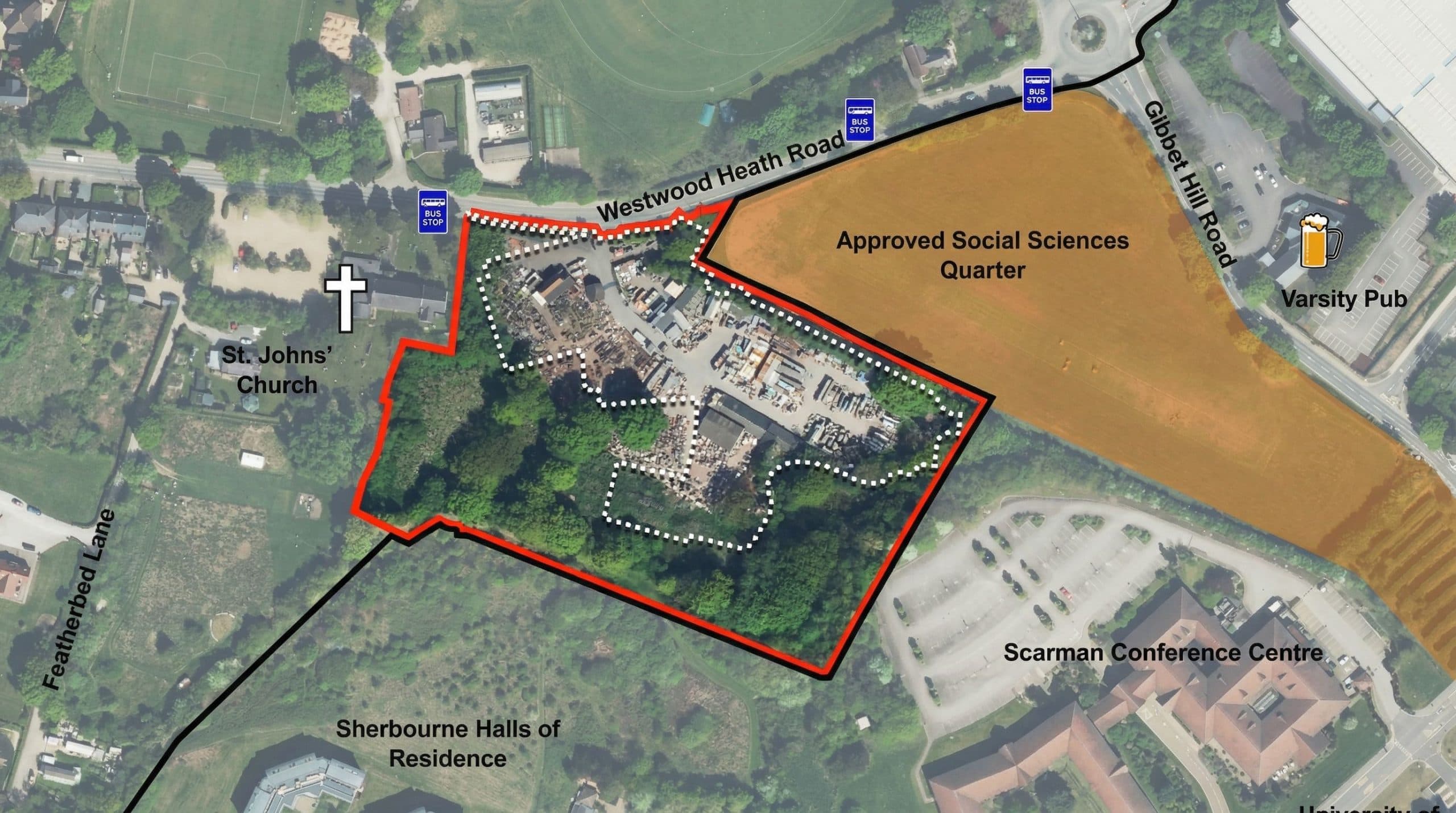

Plans have been initiated for a substantial purpose-built student accommodation project in Coventry, which will feature up to 400 beds situated adjacent to the University of Warwick. The proposal has successfully cleared its first regulatory hurdle, despite facing a petition containing over 100 signatures along with numerous letters expressing opposition to the project.
The outline planning permission was granted by the Coventry City Council, allowing the development to proceed on a site located at the County Scaffolding builder’s yard on Westwood Heath Road. This site is strategically positioned next to the main campus of the University of Warwick, which has already received separate planning permission for a new 32,000 square metre Social Sciences Quarter.
Community Concerns and Opposition
During the planning committee meeting, it was noted that the location is in proximity to the Grade II listed St John’s Church. The community’s objections have raised critical concerns, particularly regarding an alleged oversupply of student accommodation in the area. Opponents have argued that this development undermines local planning policies and could exert additional pressure on established residential communities.
Traffic congestion and safety have also been prominent issues raised by residents, with fears that the new accommodation could negatively impact local highway safety and the character of the surrounding area. In total, the council received 31 letters of objection echoing similar sentiments, which included worries about the lack of necessary infrastructure to support such a large development.
Cllr Marcus Lapsa voiced his opposition, citing that there appears to be no demonstrable need for additional purpose-built student accommodation, alongside concerns regarding highway safety and the development encroaching on “safeguarded” lands.
Planning Context and Developments
A report from the council clarified that the formal greenbelt designation for the land had been lifted to permit future developments that may cross boundaries, particularly since the site borders Warwick District. The proposed student accommodation is part of a redevelopment plan aimed at transforming an existing builder’s yard, rather than encroaching on untouched land.
Tim Brown, vice-chairperson of the Coventry Society, expressed support for the plans, indicating that they are satisfactory in principle. However, he raised concerns regarding the project’s scale, especially considering its proximity to the Grade II listed church. Furthermore, Mr Brown highlighted the need for family accommodation, as funding for the university appears to be increasingly directed towards research and postgraduate programmes, likely attracting older students.
The applicants provided a statement to the committee asserting that both the council and Warwick University have substantiated the demand for additional student bed spaces to meet projected future enrolment. They emphasised the advantageous location of the accommodation, allowing students to access the university conveniently by foot or bicycle. Notably, there were no objections from the church regarding the proposed development.
Support from Council and Planning Officers
Cllr Kevin Maton acknowledged the principle behind the scheme, yet he expressed difficulty in visualising the potential impact of the proposed four-storey and five-storey accommodation blocks. He remarked on the challenge of reconciling the ongoing conversions of residential properties to Houses in Multiple Occupation (HMOs) in nearby areas like Tile Hill and Canley, suggesting that the anticipated increase in student accommodation has not alleviated the housing issues faced by local families.
Planning officer Richard Edgington informed the committee that there have been numerous discussions regarding the need for purpose-built student accommodation, particularly in relation to Warwick University. He mentioned a report from Cushman & Wakefield commissioned in 2023, which concluded that Warwick University should be regarded as a distinct sub-market, separate from Coventry’s city centre, a viewpoint the planning department continues to uphold.
Addressing traffic-related concerns, Mr Edgington indicated that the accommodation would include 20 parking spaces, primarily designated for Blue Badge holders and for the occasional drop-off and pick-up of students at the beginning and end of terms. The development is anticipated to be largely car-free, promoting the use of public transport, cycling, and pedestrian access.
The planning officers concluded that the proposed development is deemed acceptable in principle and would not significantly impact neighbour amenity, highway safety, ecology, or local infrastructure, subject to the imposition of relevant conditions and contributions. The outline application received approval in a council meeting held on April 2, with seven votes in favour, none against, and one abstention. Detailed plans for the project will be presented in due course.