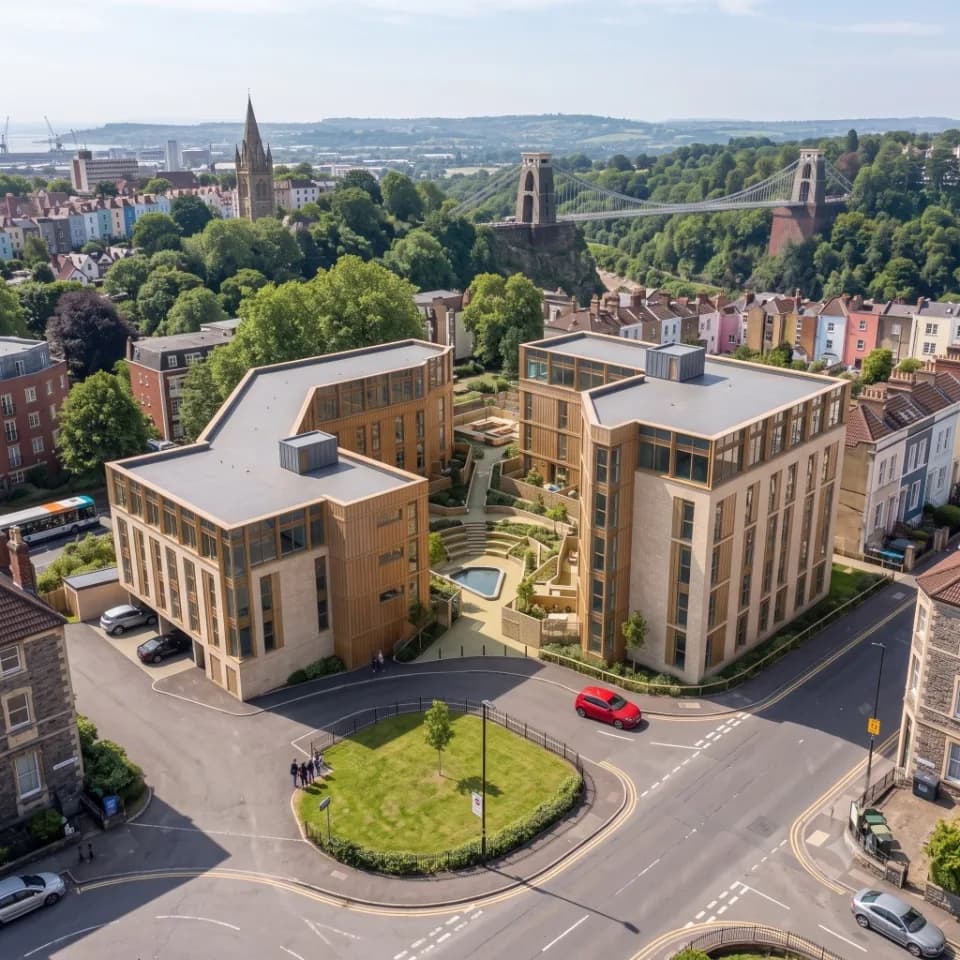
What is PBSA development finance?
PBSA development finance (also searched as a PBSA development loan, funding to build PBSA, or student accommodation development finance) is short- to medium-term lending to deliver a new Purpose-Built Student Accommodation scheme. It is not a permanent mortgage: the lender expects repayment when the asset is sold, forward-funded, or refinanced onto stabilised investment debt.
For how development finance sits in the wider stack, see the PBSA financing guide. For delivery and planning context, use the PBSA development guide.
How development loans are sized
Lenders apply both loan-to-cost (LTC) and loan-to-GDV limits. Indicative ranges only.
| Metric | Typical range | What it means |
|---|---|---|
| LTC | 60–70% | Loan as % of total development cost including fees and interest reserve |
| GDV cap | 55–60% | Loan as % of stabilised value on completion — stress lettings assumptions |
| Equity | 30–40%+ | Sponsor cash in first for land, prelims, and overrun risk |
| Term | 18–30 months | Through PC; extensions possible but costly |
Structures in detail
Senior development loan
The standard PBSA development loan: first-charge debt against the site and works, with a quantity surveyor certifying each drawdown. This is what most searches for “PBSA development finance” or “funding to build PBSA” refer to.
Underwriting focuses on planning implementability, build cost certainty, programme, developer track record, and exit visibility. Operator appointments, nomination heads of terms, or pre-letting plans reduce perceived lease-up risk and support GDV.
Typical terms & mechanics
- LTC: commonly 60–70% of total costs (land, hard costs, fees, contingency, interest)
- GDV cap: often 55–60% of stabilised value on completion
- Pricing: typically 4–7% margin over SONIA on drawn balance
- Monitoring: independent QS, monthly reporting, cost-to-complete reviews
- Equity: sponsor equity in first — typically 30–40% of total cost minimum
- Term: 18–30 months to practical completion plus short stabilisation if allowed
Best for: Developers with full planning, contractor and cost plan, and a defined refinance or sale exit
Forward funding vs development debt
Forward funding replaces or reduces traditional development debt by contracting an institutional buyer to fund milestones and acquire at completion on pre-agreed economics.
Use development finance when you keep the upside and can carry delivery and refinance risk. Use forward funding when you want a contracted exit yield and an investor balance sheet behind the build. Some deals blend forward equity with a short bridge.
Typical terms & mechanics
- Forward: yield or price per bed agreed pre-start; developer keeps construction risk
- Development loan: margin + fees; developer keeps GDV upside if market improves
- Forward common from ~£10m GDV; dev debt from ~£5m+ on strong credits
- Both require operator strategy, specification, and ESG/building safety compliance
Best for: Pipeline developers choosing between balance-sheet debt and institutional forward sale
What development lenders need
- Implementable planning and planning conditions tracker
- Fixed-price or capped construction contract and programme
- Detailed cost plan, contingency, and QS monitoring budget
- Operator or nomination strategy and lettings assumptions for GDV
- Sponsor track record, equity proof, and exit (refinance, sale, or forward fund)
- Building safety, fire strategy, and ESG specification as required by funders
Development exit and refinance
Most PBSA development loans exit onto refinance once the scheme is practically complete and let, or through a forward-funding completion or trade sale. Model DSCR and LTV on stabilised NOI before you sign the development facility — if the refinance does not work, the development loan becomes expensive bridge risk.
FAQs
What is PBSA development finance?
PBSA development finance is a construction loan used to fund the build of Purpose-Built Student Accommodation. It is drawn in stages against certified works, sized against total cost (LTC) and completed value (GDV), and repaid through sale, forward funding, or refinance onto investment debt once the scheme is let.
How much can I borrow to build PBSA?
Typical facilities cover 60–70% of total development cost and are often capped at 55–60% of GDV. Strong markets, fixed-price contracts, and operator or nomination support can improve terms. Equity funds land, prelims, overruns, and sometimes interest reserve first.
What is the difference between development finance and forward funding?
Development finance is debt from a lender with interest and covenants; you retain upside if values rise but carry refinance risk. Forward funding is an investor funding construction for an agreed forward price or yield — less refinance risk for the developer, but margin is largely fixed upfront.
How long does PBSA development finance take to arrange?
Often 8–14 weeks from mandate to first drawdown if planning, cost plan, contractor, and equity are ready. Credit approval, valuation, and legal work on the facility agreement drive the timeline. Starting lender conversations before exchange on land reduces delay.
What exit do PBSA development lenders require?
A credible take-out: refinance to stabilised senior debt (55–65% LTV), trade sale to an institution, or completion under a forward-funding agreement. Lenders stress-test GDV and lettings if the scheme opens into a soft market.